
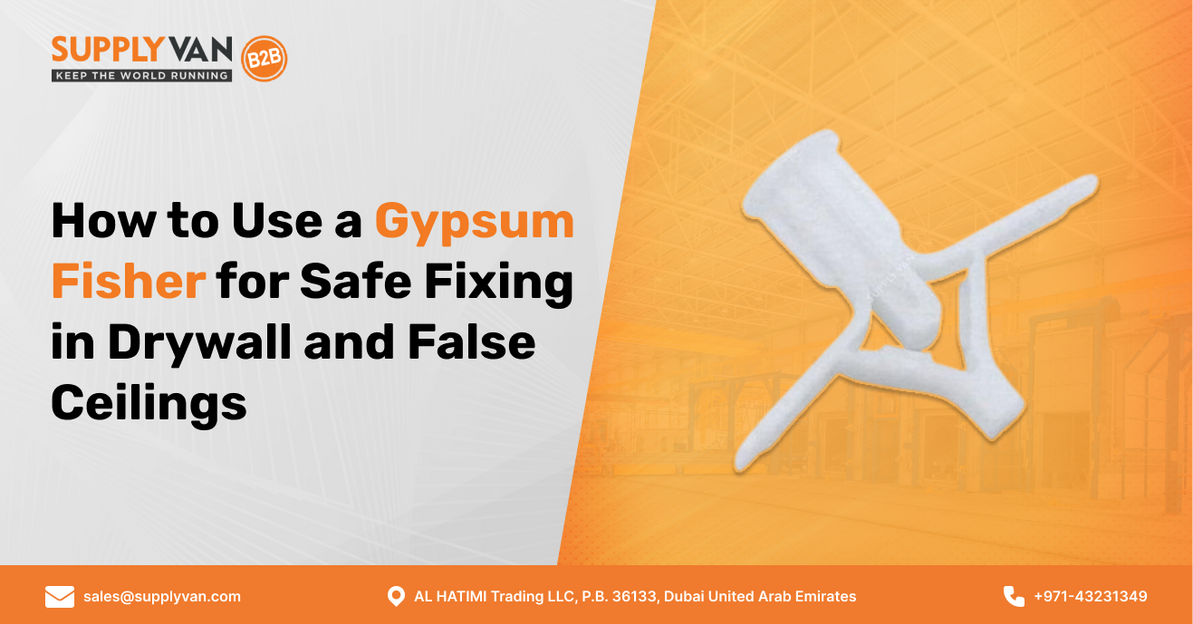
How to Use a Gypsum Fisher for Safe Fixing in Drywall and False Ceilings
You just bought a beautiful mirror for your living room. You hold it up against the wall and picture it there. Then the practical thought arrives: how do I hang this without it falling later? In most modern homes, the surface you see is drywall, also called gypsum board. It looks solid, but inside it is light and hollow.
A normal screw grips only the paper and soft core, so with enough weight, it can work loose and pull out. This happens every day in homes across the UAE. People hang pictures, shelves, even TVs, and trust the wall to hold them.
That is why a gypsum fisher exists. It is a small fixing that opens or locks behind the board, spreading the load across a wider area inside the wall. With the right anchor, the wall stops being fragile and starts acting like a proper support.
Home safety reports show that most wall-hanging failures come from using the wrong anchor or installing it poorly. Learn the right one. Use it well. After that, heavy items stay where you put them.
Now, let's start by understanding what these helpful little devices are and why your walls need them.
Key Takeaways
A gypsum fisher is a special anchor that goes inside your drywall to help screws hold weight safely. You drill a small hole, push the anchor in, and then add your screw. The anchor spreads the weight across a bigger area of the wall so things don't fall down. Different types hold different weights: light anchors for pictures (up to 10 kg), medium ones for shelves (up to 30 kg), and heavy-duty toggle bolts for mirrors or TVs (up to 60 kg or more). Always pick an anchor that can hold more weight than your item needs.
|
What You Need to Know |
The Details |
|
What is it? |
A special plug that goes in your wall to hold screws tight |
|
Why use it? |
Drywall is too soft for screws alone—you need an anchor |
|
Types available |
Self-drilling, plastic expansion, toggle bolts, and molly bolts |
|
Weight limits |
Light (up to 10 kg), Medium (10-30 kg), Heavy (30-60+ kg) |
|
Main mistake |
Tightening too much—this breaks the wall and makes it weak |
|
Best practice |
Always use an anchor rated for more weight than you need |
What Is a Gypsum Fisher and Why Do You Need One?
A gypsum fisher is a small device that makes your wall strong enough to hold things. You can also call it a wall anchor or drywall plug. Think of it as a helper that lives inside your wall.
Here's why you need one: Modern walls in UAE homes are usually made from gypsum board (drywall). This material is great for building because it's light and easy to work with. But it has one problem. It's quite soft inside. When you put a regular screw into drywall, the screw just spins in the soft material. Over time, the screw pulls out and your picture or shelf falls down.
A gypsum fisher solves this problem in a clever way. It goes into a hole in your wall. When you add a screw, the fisher expands or opens up behind the wall. This spreads the weight over a much bigger area. Your wall can now hold the weight without breaking.
Why the spreading action matters: Imagine trying to poke your finger through a piece of paper. Easy, right? Now imagine pressing your whole hand flat against that paper. Much harder to break through. That's what a gypsum fisher does—it turns a small point of pressure into a big, flat area.
The Fischer brand is one of the most trusted names for these products. But you can find good gypsum fishers from many brands. The important thing is picking the right type for your job.
You'll need a Gypsum Drywall Fisher Plug any time you want to hang something on a wall that doesn't have a wood stud behind it. Most walls have studs every 40 to 60 centimeters. But you can't always hang things exactly where the studs are. That's when you need a fisher plug to help you out.
The Different Types of Wall Anchors Explained
Walk into any hardware store and you'll see many types of wall anchors. They all do the same basic job, but each type works a bit differently.
Self-Drilling Anchors (The Beginner's Friend)
These are the easiest ones to use. They look like thick screws with wide threads. You don't need to drill a hole first. Just use a screwdriver to twist them right into the wall.
- Great for light items like picture frames or clocks
- Hold about 5 to 10 kilograms
- Very fast to install
Plastic Expansion Anchors (The Most Common Choice)
You'll see these everywhere. They're small plastic tubes that you tap into a drilled hole. When you add a screw, the plastic spreads out and grips the wall.
- Good for light to medium items
- Hold about 10 to 15 kilograms
- Very cheap and easy to find
The gypsum fisher plug in this category is perfect for hanging lightweight shelves, small mirrors, or kitchen accessories.
Toggle Bolts (The Heavy Lifters)
These are the strongest type. They have metal wings that flip open behind your wall. The wings spread the weight over a large area, which means they can hold much more.
- Perfect for heavy items like big mirrors or TVs
- Hold 30 to 60 kilograms or even more
- Need a bigger hole in your wall (about 10 to 12 mm)
A butterfly fisher for gypsum is another name for this type because the wings look like butterfly wings when they open up behind your wall.
Molly Bolts (The Removable Option)
These metal anchors expand behind the wall when you tighten them. What makes them special is that you can remove the screw later and put it back in.
- Hold medium weight (about 15 to 30 kilograms)
- Great for towel bars you might want to move later
- A bit more expensive than plastic types
How to Pick the Right Type
For light items under 5 kg: Use self-drilling anchors
For medium items (5 to 20 kg): Use plastic expansion anchors or molly bolts
For heavy items (over 20 kg): Use toggle bolts
Always check the package. It will tell you the maximum weight the anchor can hold. Pick an anchor that can hold twice as much as your item weighs. This gives you a safety cushion.
The gypsum board fisher you choose should match both your wall thickness and your item's weight.
Knowing Your Wall: Drywall vs. False Ceilings
Before you start drilling holes, you need to understand what kind of wall or ceiling you're working with.
What Is Drywall?
Drywall is also called gypsum board or plasterboard. It's the smooth surface that covers most walls in UAE homes. Here's what it's made of:
- A soft gypsum core (like compressed chalk)
- Two layers of thick paper on the outside
- Usually 12 mm thick in homes
Drywall is strong enough for regular use. But by itself, it can't hold much weight. The gypsum core is too soft.
What Is a False Ceiling?
Many homes in the UAE have false ceilings (also called drop ceilings). This is a second ceiling that hangs below the real concrete ceiling. You can spot a false ceiling because it usually has a metal grid with tiles that fit into it.
Why This Matters for Your Anchors
For regular drywall walls: Your anchor only needs to go through one layer. Most standard anchors work fine here.
For false ceilings: The ceiling tiles themselves are very weak. They can't hold any weight at all. You need to reach through the tile and attach to either the metal grid or the concrete ceiling above. Never hang anything heavy from just the ceiling tile.
How to Tell What You're Working With
Tap on your wall or ceiling with your knuckles:
- Solid, hard sound = concrete (you'll need different anchors)
- Hollow, drum-like sound = drywall (perfect for gypsum fishers)
- Very light, papery sound = ceiling tile (need to go deeper)
The Tools You Need
Having the right must-have hand tools makes the job easier:
- A tape measure
- A pencil for marking
- A drill with bits
- A screwdriver
- A level
- A stud finder
With these tools and the right knowledge about your wall type, you're ready to start installing your gypsum fishers safely.
How to Install Gypsum Fixings Step by Step
Now we get to the main event—putting your gypsum fisher into the wall. Take your time with each step.
Gather Your Tools and Pick the Right Anchor
Before you start, lay out everything you need. Here's your basic toolkit:
- The gypsum fisher anchors (buy extras)
- A drill with the correct size bit
- A screwdriver
- A pencil for marking
- A level
- A vacuum cleaner (for dust)
Matching the Anchor to Your Item's Weight
This is the most important decision. First, figure out how heavy your item is. Look at the anchor package. It will say something like "holds up to 10 kg." Pick an anchor that can hold at least twice your item's weight.
Why twice as much? Because the number on the package assumes perfect conditions. Doubling the weight gives you a safety cushion.
The gypsum fisher plug comes in many sizes. Don't try to save money by using a smaller anchor. The few dirhams you save aren't worth your mirror crashing down.
Find the Perfect Spot and Prepare Your Wall
Mark a small dot with your pencil where you want to hang your item. Use your level to make sure it's straight.
Check for Hidden Dangers
Behind your walls run electrical wires and sometimes water pipes. Look for these warning signs:
- Light switches and outlets (wires run up and down from these)
- Water stains (might mean pipes nearby)
Stay at least 15 cm away from any outlet when drilling.
Check Your Wall Condition
Press on the wall where you plan to drill. It should feel solid. If the drywall feels soft or crumbly, pick a different location. An anchor in damaged drywall won't hold.
Installing Self-Drilling Anchors
These drill their own hole as you screw them in.
Step 1: Hold the anchor against your pencil mark pointing straight at the wall.
Step 2: Use a screwdriver to start turning the anchor. Apply firm pressure pushing into the wall while you turn.
Step 3: Keep turning steadily until the head is flush with the wall surface.
Step 4: Take your screw and turn it into the anchor. Go slowly. Stop as soon as you feel firm resistance.
Installing Anchors That Need a Pilot Hole
Most gypsum board fisher anchors need you to drill a hole first.
Step 1: Pick the Right Drill Bit
The anchor package tells you what size hole to drill. Use exactly that size. Too small and the anchor won't fit. Too big and it won't grip.
Step 2: Drill the Hole
Hold the drill with both hands. Place the bit tip on your pencil mark. Make sure the drill points straight into the wall. Start at medium speed. Push gently but steadily until you go through the drywall.
Step 3: Clean and Insert
Blow out the dust. Push the anchor into the hole until it's flush with the wall surface. Some types need a gentle tap with a hammer.
Step 4: Add Your Screw
Turn the screw into the center of the anchor. Stop when it's snug. Don't overtighten. Use a manual screwdriver for better control.
Installing Toggle Bolts for Heavy Items
Toggle bolts have metal wings that spring open behind your wall. The butterfly fisher for gypsum works this way.
Step 1: Drill the Right Size Hole
Toggle bolts need bigger holes—usually 10 to 12 mm. Check your package.
Step 2: Prepare the Toggle Bolt
Thread your bolt through whatever you're hanging first. You can't add it after the wings are in the wall.
Step 3: Fold and Insert the Wings
Hold the wings together with your fingers. Push them through the hole. You'll feel them pop open behind the wall.
Step 4: Tighten While Pulling Back
Keep pulling back on the bolt while you tighten it. This keeps the wings pressed against the back of the drywall. Turn slowly until tight.
Step 5: Test Before You Trust
Give it a gentle pull. It should feel completely solid.
Special Steps for False Ceilings
For Light Items: You can attach directly to the metal grid bars using special clips.
For Heavy Items: You need to go all the way up to the concrete ceiling. Use a long toggle bolt that reaches through the gap. You'll drill through the tile, through the air gap, and into the concrete above. Use a concrete anchor in the concrete ceiling.
Safety Note: Always use anchors rated for ceiling use when hanging things overhead. Never use simple expansion anchors on ceilings.
After Installation: The Final Checks
Before you hang your item:
- Check if the anchor is flush with the wall
- Try to wiggle it (should feel completely solid)
- Make sure everything is level
- Clean up the dust
Give your installation 24 hours before putting full weight on it. Check again after a week to make sure nothing has shifted.
Common Mistakes That Make Anchors Fail
Overtightening (The Number One Problem)
When you overtighten, you crush the gypsum inside your wall. The anchor loses its grip. Tighten until you feel firm resistance, then stop.
Using the Wrong Size Anchor
Always check the weight rating. Use an anchor rated for at least twice your item's weight. If in doubt, go bigger.
Drilling Holes Too Big
Use the exact drill bit size the package recommends. A hole that's too big means the anchor won't grip.
Putting Anchors in Damaged Walls
Old holes are weak spots. Move at least 5 cm away from any old hole.
Hanging Too Much Weight on One Anchor
Use at least two anchors for any shelf or heavy item. This spreads the weight and gives you a safety margin.
Installing Too Close to Edges
Keep anchors at least 5 cm away from any corner or edge. Edges can crack and crumble.
Testing Your Installation and Staying Safe
The Gentle Test
Touch the screw head. Try to wiggle it. It should feel rock solid. Apply gentle downward pressure with your hand. The anchor shouldn't move.
When to Use Multiple Anchors
Always use at least two anchors for:
- Shelves longer than 30 cm
- Mirrors larger than 40 cm
- TV mounts
- Towel bars
- Curtain rods
Items That Always Need Wall Studs
Some things are too heavy for anchors alone:
- TVs larger than 32 inches
- Heavy kitchen cabinets
- Full-length mirrors
- Anything children might pull on
For these, find the wooden studs and screw directly into them.
Checking Your Work After Installation
- After 24 hours: Has anything shifted?
- After one week: Give it a gentle shake. Still solid?
- Every few months: Quick visual check for cracks or sagging
Quick Tips for Success
Always Read the Package Instructions
The package tells you the hole size, weight capacity, and special steps. Read it before you start.
Go Slow and Gentle
Speed causes mistakes. Take your time with each step.
Use the 25% Rule
Only load an anchor to 25% of its maximum rated weight for long-term safety. So an anchor rated for 20 kg should only carry 5 kg for years of safe use.
When in Doubt, Ask for Help
Ask someone at the hardware store, watch a video online, or call a handyman for advice.
Conclusion
You now know how to use a gypsum fisher safely and correctly. You understand why these small anchors are so important for hanging things on drywall. You know the different types and when to use each one.
Remember the key points: Always match your anchor type to your item's weight. Pick anchors rated for at least twice what you're hanging. Test your installation before trusting it with expensive items.
The mistakes people make—overtightening, wrong anchor size, damaged walls—are all easy to avoid once you know what to watch for. Take your time. Follow the steps. Check your work as you go.
Whether you're hanging a small picture frame or a large mirror, the right anchor installed the right way will hold safely for years.
Ready to start your project? Supplyvan offers a complete range of quality gypsum fishers and wall anchors, along with all the tools you need for safe installation. Visit Supplyvan for expert advice and the right products for your UAE home.
Frequently Asked Questions
Can I reuse a gypsum fisher anchor if I remove the screw?
It depends on the type of anchor. Molly bolts are designed to let you remove and replace the screw multiple times without removing the anchor itself. Toggle bolts and plastic expansion anchors usually can't be reused. Once you remove the screw from an expansion anchor, it often loses its grip on the wall. For items you might move later, choose molly bolts from the start so you can remove screws without redoing the whole installation.
What should I do if the anchor spins in the hole when I try to tighten the screw?
This means your pilot hole is too big for the anchor. Stop trying to tighten it. Remove the anchor carefully. You have two options: use a larger anchor that fits the bigger hole, or patch this hole with spackle and move your installation 5 to 10 cm to a new spot. The second option is usually better because it gives you a fresh start in undamaged drywall.
How do I know if my wall is too damaged to hold an anchor safely?
Press firmly on the wall with your palm. If it feels spongy or soft, the drywall is damaged. Look for visible signs like cracks, water stains, or peeling paper. If you drill a hole and lots of crumbly white powder comes out, the gypsum is degraded. In any of these cases, either move to a different wall section at least 30 cm away, or repair the damaged drywall before installing anchors.
Can I install gypsum fishers in outdoor walls or wet areas like shower walls?
Standard gypsum board isn't made for direct water contact. In bathrooms, you can use regular gypsum fishers in dry wall areas, but use moisture-resistant anchors. Never install anchors in actual shower walls. For outdoor walls in UAE, check if your wall is concrete. Concrete needs masonry anchors, not gypsum fishers. If you have outdoor drywall protected from rain, use galvanized or stainless steel anchors to prevent rust.
How long should I wait before putting full weight on a newly installed anchor?
For most anchors, you can load them immediately if needed. However, it's smart to wait about 30 minutes to an hour before adding full weight. This gives the anchor time to settle. For toggle bolts in ceilings, wait 24 hours before adding maximum weight to be extra safe. If you used wall patching compound, wait until that's completely dry (usually 24 hours). Add weight gradually and watch for any signs of movement.
Recent Posts
-
Hand Tools List for Industrial Maintenance and Repair
When a machine breaks down on a production floor in Dubai, UAE, the tools your team reaches for firs …23rd Mar 2026 -
What Are MRO Products? Complete Guide for Industrial Buyers
Running a factory, workshop, or facility in Dubai means keeping operations tight, efficient, and saf …13th Mar 2026 -
Where to Buy Ducab Cable in Dubai – Trusted Suppliers Guide
If you work in construction, electrical contracting, or facilities management in Dubai, you already …9th Mar 2026